


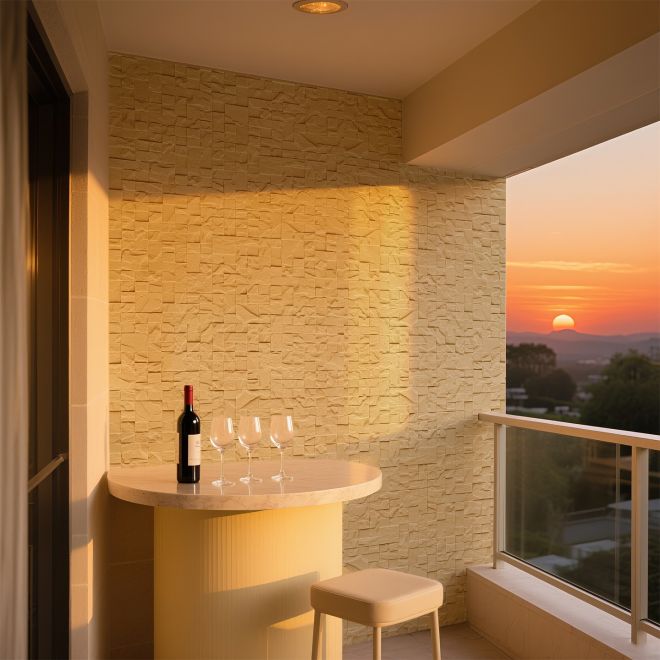
The soft porcelain industry is currently in a period of rapid growth, showing a trend towards greenization, intelligence, and diversified scenarios. The global market size is expected to exceed 15 billion US dollars by 2030, with China's annual growth rate reaching 18%, significantly higher than the global level.
On the policy side, both domestic and international green building and low-carbon policies continue to intensify, promoting the upgrading of environmental protection in the industry;
Technologically, technological iterations such as nanomodification and digital printing have led to the emergence of innovative products that are thinner, more durable, and environmentally friendly.
Convenient demand, strong demand in commercial spaces, medical and educational institutions, as well as in the fields of renovated and prefabricated residential buildings, has led to a rapid increase in the supporting rate of finely decorated properties.
Policy technology dual wheel drive accelerates high-quality development of the soft ceramic industry
Major projects in multiple regions have landed, and green production capacity continues to be released
In November 2025, Jiangsu Xinshi New Building Materials Technology Co., Ltd.'s annual production of 1.5 million square meters of soft porcelain project entered the trial production stage. As a major industrial project in Suining County, the project adopts an integrated automatic production line to achieve intelligent processing of the entire process from raw materials to finished products. One worker can simultaneously take care of two production lines, with a daily output of 3000 square meters.
The thickness of the soft porcelain products produced by it is only 2-6 millimeters, and the service life can reach 30 years, which is more than five times higher than traditional stone paint. The construction process is dust-free, pollution-free, and noise free. Currently, 60% of orders come from international markets such as Southeast Asia and the Middle East.
After reaching full production capacity, the annual output value will reach 50 million yuan. During the same period, Henan Green Building New Materials Co., Ltd. invested 285 million yuan in the soft porcelain and flexible decorative brick project in Jian'an District, Xuchang. The project integrates industry university research resources, adopts low-temperature calcination technology, and adds 30% cement tailings to the raw materials to achieve solid waste resource utilization. After reaching production capacity, it will form an annual output of 5 million square meters, and the annual operating income is expected to reach 475 million yuan.
Technological innovation breaks through bottlenecks, green and low-carbon become core competitiveness
Top enterprises are leading the industry upgrade with technological innovation. Marco Polo Holdings' independently developed green and low-carbon manufacturing technology has been selected as an advanced technological innovation achievement in the light industry during the 14th Five Year Plan period. Through technological breakthroughs, it has achieved high content utilization of industrial solid waste such as lithium mine tailings and wollastonite tailings, and built industry-leading distributed photovoltaic power stations with an annual power generation of over 160 million kWh and a cumulative reduction of about 128000 tons of carbon dioxide emissions.
Mona Lisa Group has taken the lead in achieving full coverage of the ammonia hydrogen zero carbon combustion demonstration line in the ceramic industry, becoming the first Guangdong Hong Kong carbon label mutual recognition and certification enterprise in the ceramic industry. Its four major production bases have all been rated as national "green factories", and have won two awards including the "2025 Best A-share ESG Practice Award" for outstanding practices in the ESG field.
On the application side, photovoltaic integrated soft ceramics have become a new hotspot. The Guangdong Nankong 2098KW distributed photovoltaic project has been successfully connected to the grid, and the supporting soft ceramic components have achieved the integration of power generation and decoration functions. The annual power generation has reached 2.19 million kWh, saving 1.9 million yuan in electricity bills; The urban renewal project of Pinggu South Community in Beijing adopts a combination of soft ceramic materials and light colored photovoltaic walls to create a zero carbon building facade demonstration project,
The policy and market are mutually reinforcing, and the development space of the industry continues to expand
At the policy level, the national "dual carbon" strategy and the "Work Plan for Stable Growth of Light Industry (2025-2026)" continue to be strengthened. Henan Province has clearly proposed to cultivate leading enterprises in new building materials and promote the large-scale development of products such as flexible decorative tiles. With the implementation of the 14th Five Year Plan for Building Energy Efficiency and Green Building Development, the requirements for comprehensive greening of new buildings in cities and towns, as well as the increase in the proportion of prefabricated buildings, let the penetration rate of soft porcelain in old renovation, medical and educational institutions, fine decoration buildings and other scenes increase rapidly.
At present, the penetration rate of domestic soft porcelain market is less than 5%, but there is still huge room for growth compared with the level of 25% in developed countries in Europe and the United States. Superimposed by the "the Belt and Road" and RCEP tariff advantages, the demand for soft porcelain in Southeast Asia, the Middle East and other regions has surged, promoting the continuous increase in the proportion of industry exports, and forming a development pattern of domestic and international double circulation and mutual promotion.
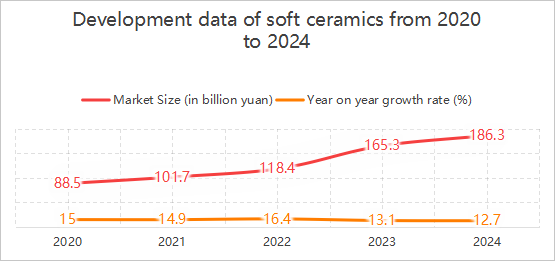
Data source: Comprehensive data from "Analysis Report on Market Share and Industry Competition Pattern of Chinese Soft Porcelain in 2025"
 Privacy settings