


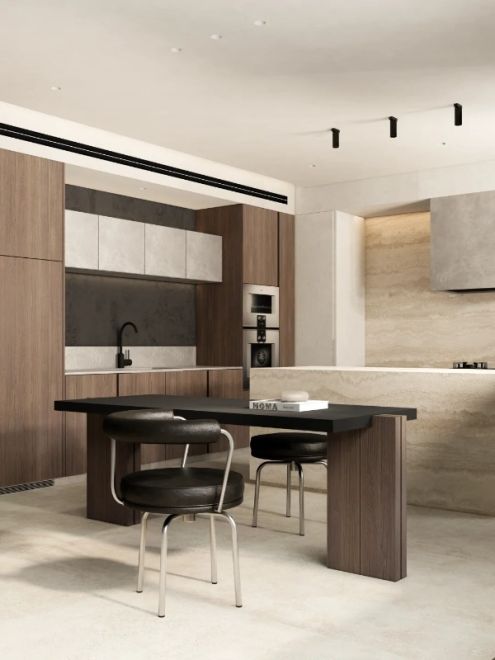
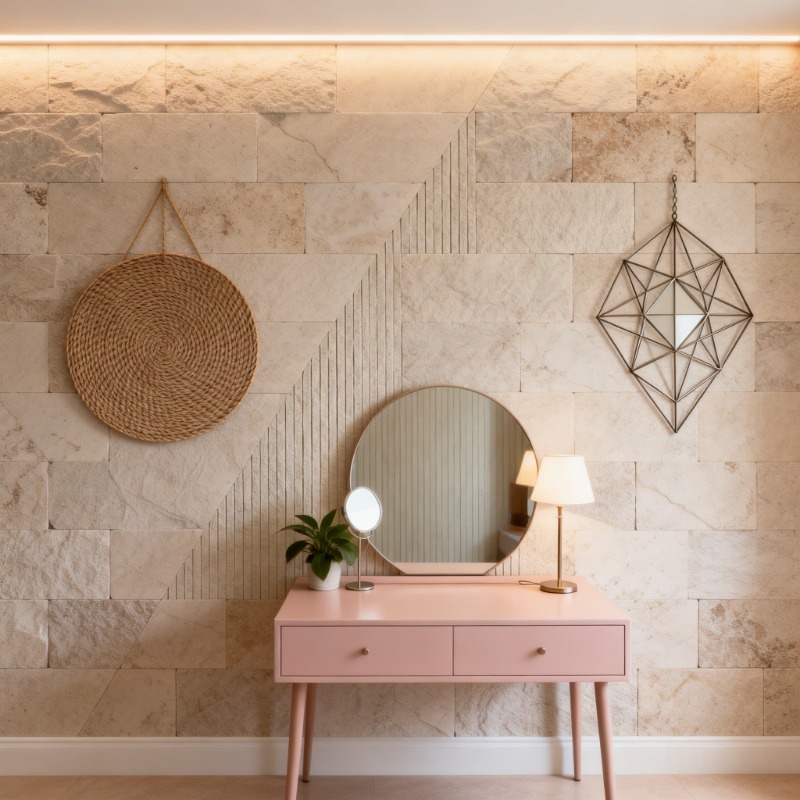
Many people confuse flexible ceramic tiles with traditional ceramic ones, but they are actually quite different. Also known as flexible facing tiles, flexible ceramic tiles are manufactured in line with industry standards: they use natural minerals like clay and quartz sand as the base material, mixed with eco-friendly polymer modifiers, and are fired at a low temperature of 120-180℃.
Their core strengths lie in inorganic environmental protection and flexible adaptability, and they are not a derivative of traditional ceramic materials. Innovations in its production process and ingredients make it a technical standout. Unlike traditional ceramic tiles, which require firing at over 1200℃, the low-temperature process of flexible ceramic tiles cuts energy consumption by more than 60%. Natural minerals account for 80% of its raw materials, and some products even recycle construction waste.
The entire production process is pollution-free, with a formaldehyde emission of ≤0.02mg/m³, far below the national standard limit. Modified with radiation cross-linking technology, these tiles combine the weather resistance of inorganic materials with the flexibility of organic ones.
They can bend to a radius just 10-15 times their own thickness and won’t crack even when bent into a 20cm-diameter arc. Its outstanding performance is clearly shown in test data. Third-party tests prove that high-quality flexible ceramic tiles remain intact after 2000 hours of artificial aging tests. After 25 freeze-thaw cycles at temperatures ranging from -20℃ to 20℃, they retain over 85% of their bonding strength, making them suitable for extreme temperature changes. Weighing only 3-5kg per square meter—less than one-fifth of traditional ceramic tiles—they greatly reduce building load and fundamentally avoid the risk of exterior wall falling off high-rises.
Compared with traditional materials, flexible ceramic tiles offer an excellent cost-performance ratio. They can replicate the texture of natural stone with over 95% realism but cost only one-third to one-half the price of natural stone, and no mining is needed for their production.
Compared with real stone paint, their aging resistance lasts more than 50 years, far exceeding the 5-8 year service life of real stone paint. They need no complex base treatment during construction, with a laying speed nearly three times that of traditional ceramic tiles, and can even be directly pasted on existing walls in renovation projects. Currently, flexible ceramic tiles are widely used in high-rise exterior walls, renovation projects, special-shaped buildings and other scenarios.
They align with the trend of green construction and solve many pain points of traditional building materials, emerging as a technical benchmark in the building materials industry that excels in both practicality and environmental protection.
Key News Highlights of the Flexible Ceramic Tile Sector, January 2026 News coverage of the flexible ceramic tile sector in January 2026 focuses on four core dimensions: **policy implementation, technological patents, market dynamics and industry analysis**. Below are the key takeaways and essential information:
Ⅰ. Policy and Standard Updates
- The *General Principles for Selecting High-Quality Building Materials* has taken official effect since January 1, 2026. Flexible ceramic tiles perform outstandingly in four core indicators: health, safety, environmental protection and quality, with high-end products meeting the 5A international advanced standard. This provides an authoritative basis for market material selection.
- Many regions have increased subsidies for green building materials: Quanzhou offers rewards of 40,000 RMB and 30,000 RMB per certificate for flexible ceramic tiles with three-star and two-star green building material certification respectively, and government procurement gives priority to such certified products; Ningxia includes flexible ceramic tiles in the home kitchen and bathroom renovation subsidies, with individual consumers enjoying a 15%-20% subsidy (capped at 5,000 RMB) for purchases.
Ⅱ. Technological and Patent Progress
- Published on January 12: Jiangxi Zhuoao Technology’s patent for **Intelligent Production Equipment for Flexible Ceramic Insulation Panels** (CN121290575A). The technology enhances the structural strength of materials through S-shaped fiberglass mesh laying, adapts to the production of energy-saving building materials, and optimizes the exhaust and shaping processes before drying.
- The industry is accelerating technological upgrading: Leading enterprises have realized the **small-batch customization + zero-inventory production** model, with a minimum order of 1 square meter. They can adjust formulas according to regional climatic conditions (moisture-proof for southern China, freeze-resistant for northern China). Technologies such as self-healing coatings and digital texture libraries have become the core competitiveness in the mid-to-high-end market.
Ⅲ. Market and Project Dynamics
|
Date |
Event |
Core Information |
|
January 5th |
Wuxi, Jiangsu won the bid |
Wuxi Shangxian Shunrong Primary School purchased domestic soft tiles at a unit price of 125 yuan/m², with the highest single-project bid amount reaching 6,375 yuan |
|
Mid-February |
Project Case Implementation |
The 500㎡ wall renovation project at Zhouning Puyuan Ancient Style Block in Fujian was completed in 30 days (15 days ahead of schedule), while projects such as the Wuli Street renovation in Yongchun demonstrated the high-efficiency construction advantages of soft ceramic tiles |
|
Late January |
Industry Landscape Analysis |
65% of global production capacity is concentrated in China, with top domestic R&D investments accounting for 5.7%, and structural design patents surpassing those of Europe and the US; the market exhibits a dumbbell shape, with Europe dominating the high-end segment while the low-end segment faces persistently rising attrition rates |
Ⅳ. Industry Trend Insights
- The flexible ceramic tile market is projected to hit 12 billion RMB in 2026, with an annual growth rate of 25%. Its adoption is rising in high-rise buildings, urban renewal and public construction projects, driven by core strengths of light weight and safety, efficient construction, and green low-carbon features.
- Brands like Jiangsu Neolithic are fueling the application of flexible ceramic tiles in eastern China’s urban renewal and green building projects through regional benchmark cases and technological innovation, driving the industry to shift from price competition to competition based on performance and services.
 Privacy settings